

Guide · 5-minute read
Paying your cards in full: how to know what you can really spend
Your bank balance isn’t what you can spend when cards are paid in full. How statements work, which figure to subtract, and a worked example.
Paying your credit cards in full every month is one of the simplest good habits in personal finance. You use the card for convenience and its rewards, and the statement is cleared each month.
But it creates a quiet puzzle. Your checking account shows one number. Some of that money is already promised to your cards. And some of what’s on your cards isn’t due yet at all.
So what can you actually spend today? Not “what’s in the bank” — and, perhaps surprisingly, not “what’s in the bank minus everything on the cards” either.
Two dates that matter on every card
Every credit card runs on two dates each month:
- The statement closing date. Everything charged up to this day goes on the statement. The card adds it up and tells you what you owe.
- The payment due date, usually a few weeks later. Pay the statement in full by then, and that statement is settled.
Anything you charge after the closing date goes on the next statement. You owe it, but it isn’t due until the following month.
So at any moment, a card paid in full holds two kinds of money:
- 1The statement that has closed — due soon, and the money for it has to be ready.
- 2What you’ve charged since — owed, but not billed yet.
Three numbers, and why only one answers the question
Take any day of the month and you can work out three figures:
- What’s in the bank. Too generous: part of it belongs to the closed statement.
- What’s in the bank, minus every card’s whole balance. Too cautious: it takes away this month’s purchases as well, which you’ll pay out of next month’s income, as you always do.
- What’s in the bank, minus the statement that has closed on each card — less whatever you’ve already paid toward it. This is the one. It’s the money that is genuinely free today.
And the purchases since the statement closed? Keep them in view, next to that figure. They’re already spent — you just don’t have to pay for them yet.
A worked example: John and Mary
John and Mary are an example household. Every figure here is invented.
It’s October 20. John and Mary pay both their cards in full every month.
In the bank: checking 6,150.00 and cash 250.00 — 6,400.00 in all.
Card A closes on the 3rd and is due on the 28th.
- The October 3 statement came to 1,240.00. Nothing paid yet.
- Since October 3 they’ve charged 610.00.
Card B closes on the 12th and is due on the 6th of the next month.
- The October 12 statement came to 380.00. They’ve already paid 100.00 toward it.
- Since October 12 they’ve charged 95.00.
Now the three numbers:
| Works out as | Result | |
|---|---|---|
| What’s in the bank | 6,400.00 | |
| Minus every card’s whole balance | 6,400.00 − 1,850.00 − 375.00 | 4,175.00 |
| Minus what’s due next on each card | 6,400.00 − 1,240.00 − 280.00 | 4,880.00 |
And beside it: 705.00 charged since the statements closed (610.00 + 95.00) — not billed yet.
So John and Mary have 4,880.00 that is genuinely theirs to use today. The 1,520.00 for the two statements is spoken for. The 705.00 of newer purchases is visible, so it doesn’t come as a surprise, but it belongs to November’s statements and November’s income.
If they had only looked at the bank, they’d think they had 1,520.00 more than they do. If they’d taken off every card’s whole balance, they’d think they had 705.00 less — and might put off something they had planned and could afford.
Habits that make this easy
- Write down each card’s closing day and due day. They’re on the statement. Most cards don’t close at the end of the month, so a calendar month is the wrong guess for most of them.
- Plan the card payment as what it really is: last month’s spending, paid this month. It isn’t a new expense; it’s the spending you already planned.
- Look at the figure, not the balance, before a large purchase. “Is it free after the statements are paid?” is the honest question.
- Know what paying in full usually does for you. On most cards, paying the statement in full each month means purchases don’t attract interest. Card terms differ, so check your own cardholder agreement.
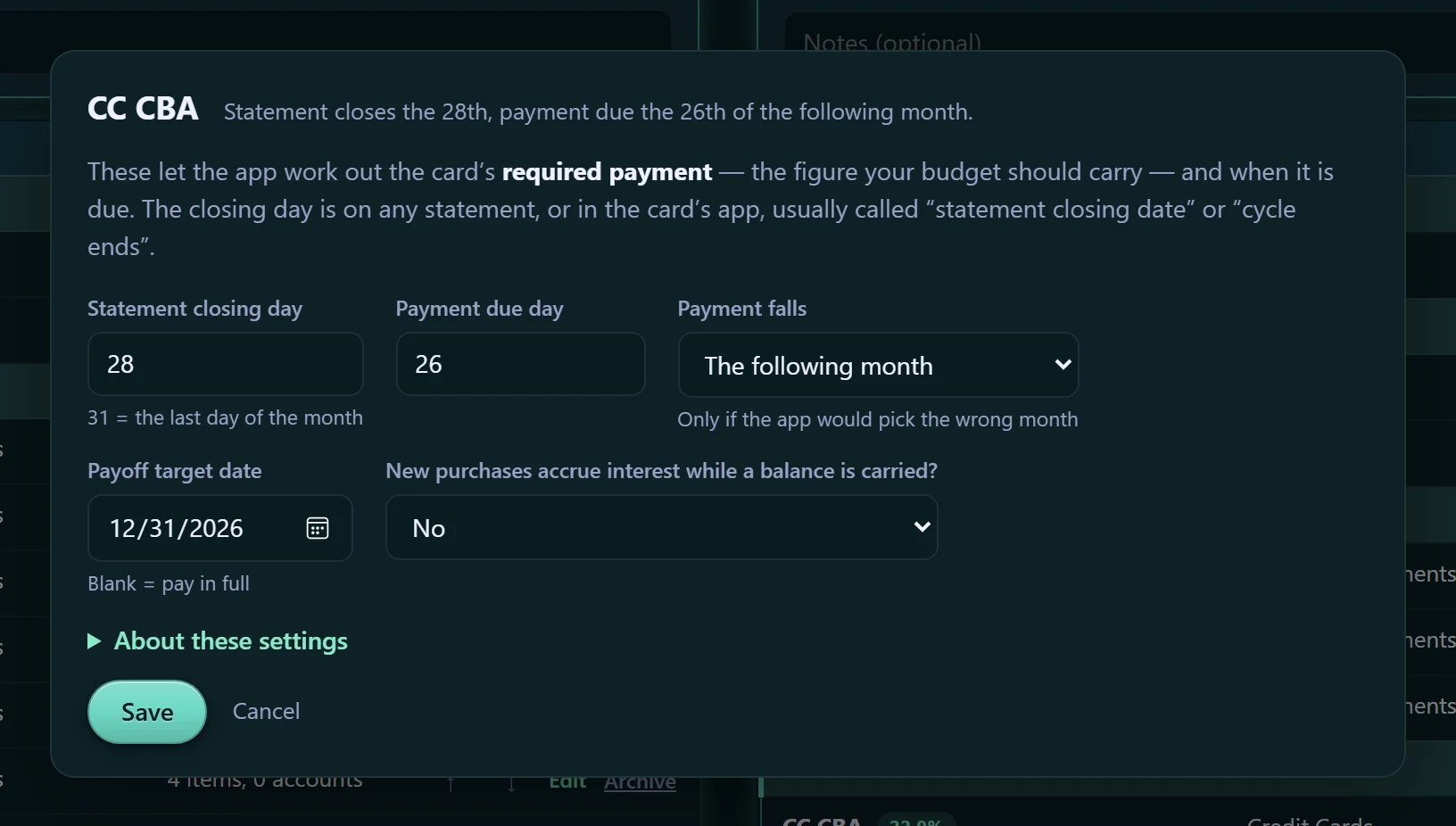
What if one card is being paid down?
Many households pay one card in full and pay another down over a few months. That card works differently: what’s due next is the instalment you’ve set yourself, plus the new spending on it, which you still pay in full. The rest of its balance is spread over the months to come, so it isn’t taken from today’s figure all at once.
Mixing the two kinds of card is normal. The method above still holds: for each card, take away what’s due next, nothing more and nothing less.
Doing it in Quantum Budget
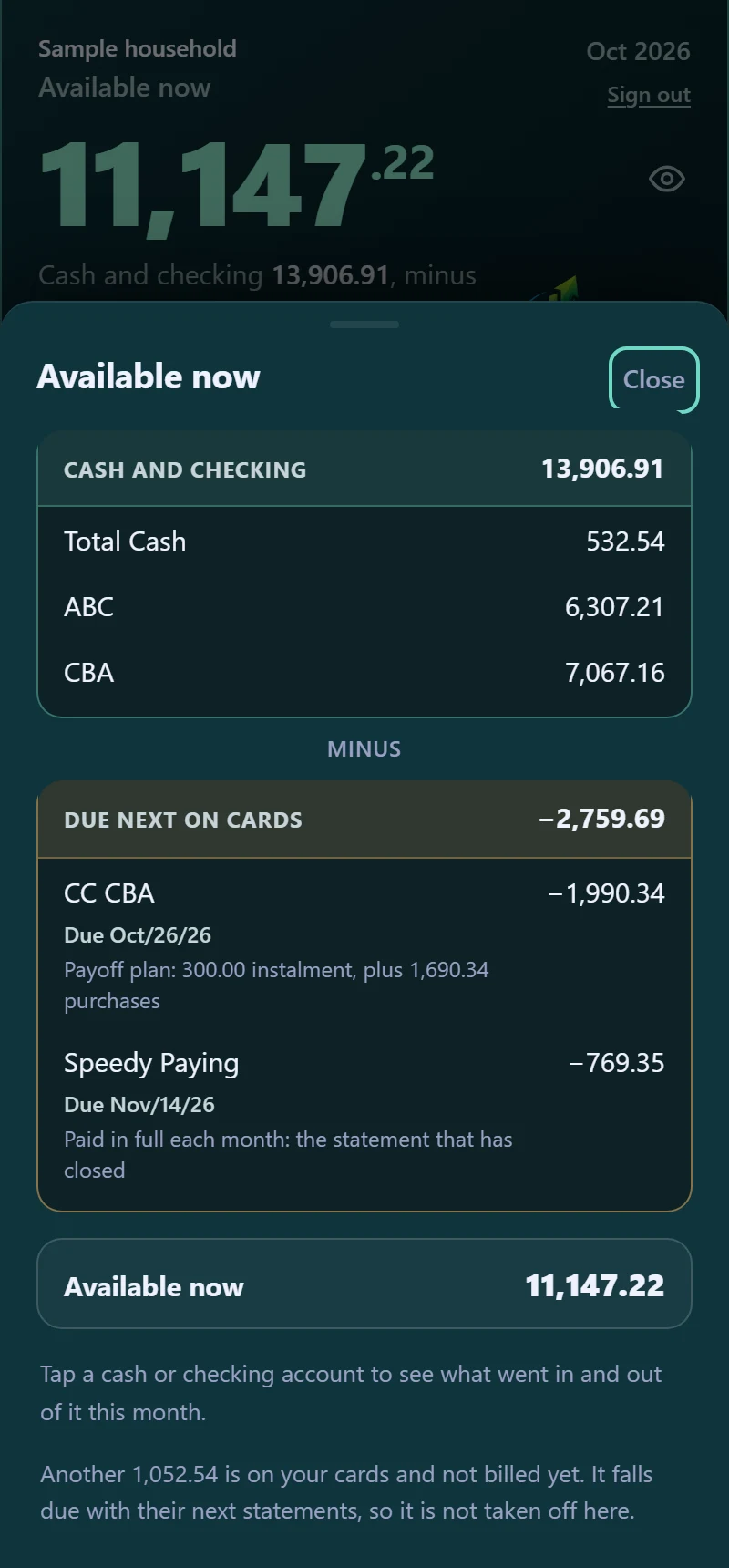
This is the figure Quantum Budget puts at the top of the phone and the computer. It’s called Available now: cash and checking, minus what’s due next on each card.
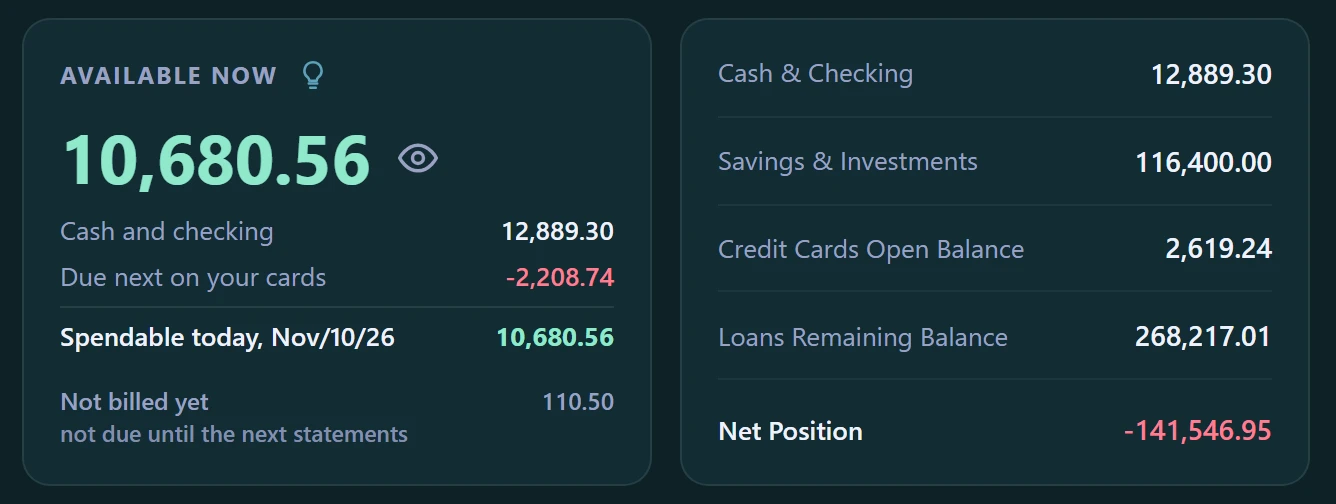
- For a card you pay in full, that’s the statement that has closed.
- For a card on a payoff plan, it’s the instalment plus new spending.
- Either way, what you’ve already paid toward that statement comes off.
- What you’ve charged since the statement closed is shown beside it as not billed yet — in sight, but not subtracted.
You give each card its closing day and due day once, in Setup, and the app says back to you in words what you saved (“Statement closes the 15th, payment due the 10th of the following month”), so a typing slip shows at once. From then on, “What’s due next, card by card” lists every card, the one to pay soonest first.
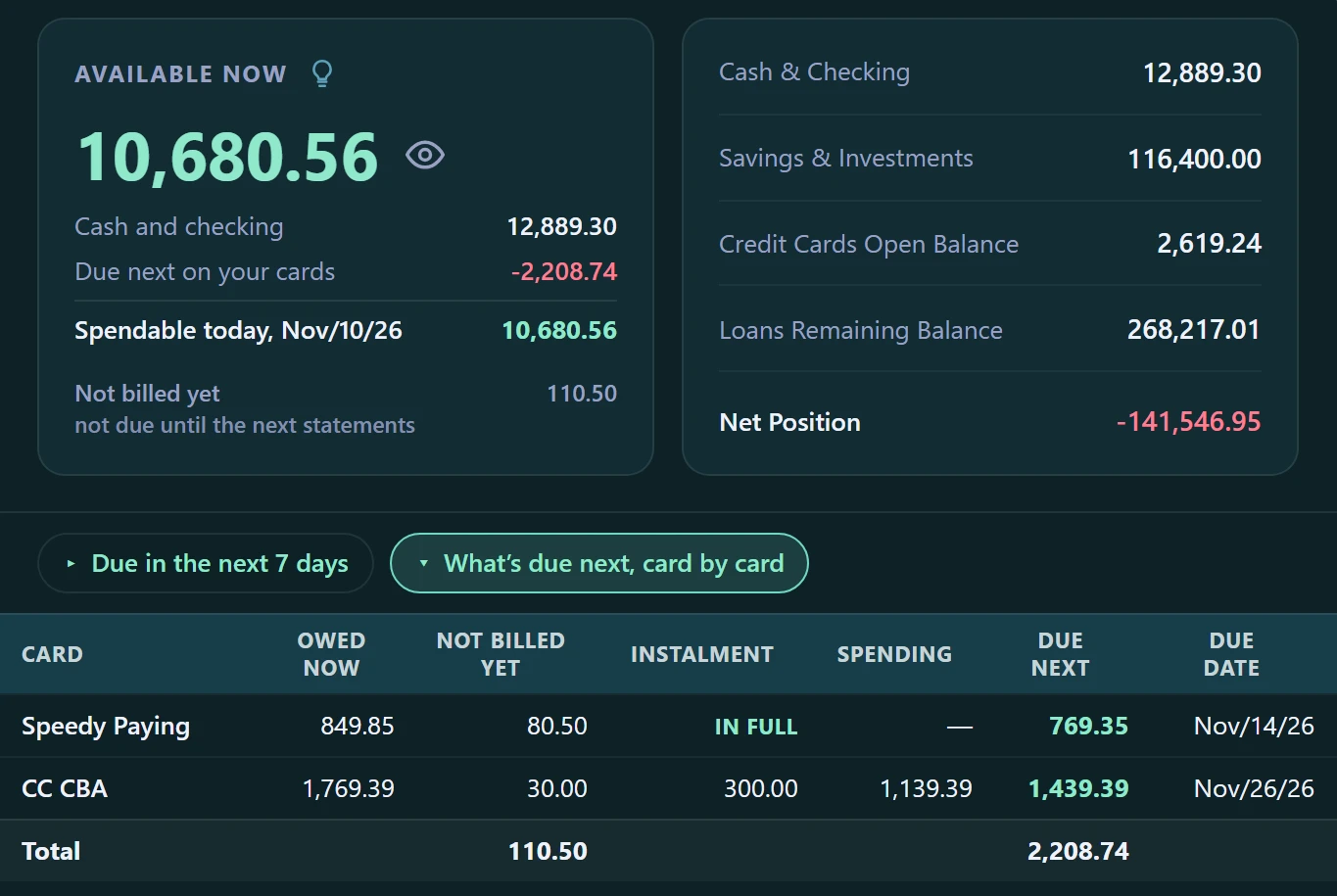
Available now is in both plans, Light and Pro, on your computer and your phone. There’s no bank login: you enter your purchases, photograph receipts, or bring in the file your bank or card already offers for download.
30 days free
Try it for 30 days
Light shows where you stand. Pro also shows where you are heading.
Light: US$4.99 a month or US$39 a year
Pro: US$8.99 a month or US$79.99 a year
30 days free on either plan. Your card is taken at the start and not charged for 30 days; cancel within them and you pay nothing.
See the plans and start 30 days free
If you’re working on paying a balance down, the free Debt-Free Date Calculator on our website shows the month your last payment lands — try it, no account needed.
Quantum Budget is budgeting software. It does not connect to a bank, does not hold or move money, and nothing in this article is financial advice.